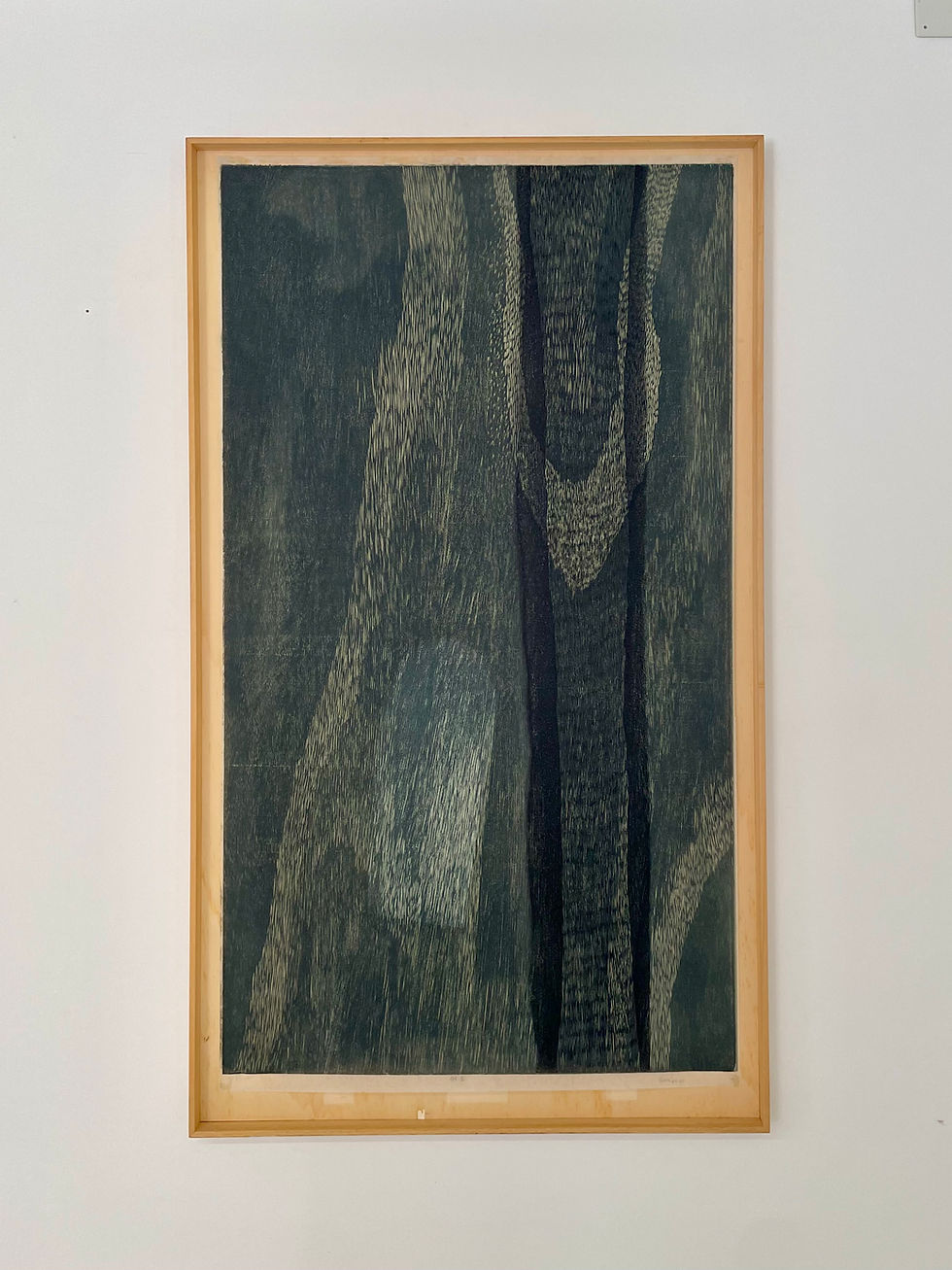
Rosanna Rossi: Xilografie e un dipinto (2026)
- Apr 1
- 13 min read
1 April - 13 June 2026
Efisio Carbone — Infinite lines, a single research, catalog text "Rosanna Rossi", Edizioni Museo Ettore Fico, Turin 2025 :
Within the plural and complex landscape of post-World War II Italian art, Rosanna Rossi represents a rigorous and coherent figure, capable of navigating sixty years of artistic research while maintaining absolute fidelity to her own vision and method. Her work develops quietly but continuously, far from any fashion or compromise, within a peripheral context such as that of Sardinia. Yet, precisely because of this liminal position, it succeeds in becoming an active crossroads of international languages, tensions, and research.
Rosanna Rossi’s path traverses expressionist figuration, lyrical abstraction, analytical painting, matter, and finally, installational experimentation, giving life to a dense and layered corpus. Today, through recent re-readings, this body of work finds its rightful place within the history of contemporary Italian art.
The context in which the artist was born and formed is that of a Sardinia still suspended, in the 1950s, between a visual culture anchored in identity and folklore and the first signs of openness to contemporary poetics. After the birth of the Autonomous Region in 1948, the island remained largely tied to the nineteenth-century pictorial models of Figari, Floris, Ballero, and Delitala. The great 1949 exhibition at the Opera Bevilacqua La Masa in Venice, which juxtaposed Nuragic art with contemporary Sardinian art, marked the first attempt at a symbolic break with the past, but the real turning point only matured at the end of the 1950s.
It was during those years that Sardinia entered the international debate thanks to figures such as Mauro Manca - winner of the Premio Sardegna with the aniconic work L'ombra del mare sulla collina (1957) - and through the founding of avant-garde groups such as Studio 58 in Cagliari and Gruppo A in Sassari. Within this climate, Rosanna Rossi’s path took shape. After studying first in Florence at the Collegio di Poggio Imperiale and then in Rome at the Istituto d’Arte Zileri, where she concluded her training in 1956, the artist chose to return to Sardinia. Her return coincided with the birth of the Studio 58 group, in which Rossi would play a decisive role.
Studio 58 constituted a true laboratory of artistic modernity. Founded in 1958 by a group of young artists restless with the island's academic conservatism, the group gathered around Franz Vespa, a Swiss optician who provided his exhibition spaces in Cagliari. Among the protagonists, alongside Rossi, were Gaetano Brundu, Primo Pantoli, Mirella Mibelli, Anna Cabras Brundo, Biagio Civale, and others. The group positioned itself as a peripheral avant-garde in constant dialogue with international post-war languages: European Informalism, Spazialismo, French Tachisme, and the first signals of Pop Art.
As noted by critic Salvatore Naitza, Studio 58 represents a conscious attempt to place Sardinia no longer on the margins, but within European visual modernity, with the aim of overcoming identity-based self-referentiality. The role of women artists within the group - Rossi, Mibelli, Cabras Brundo - is of great importance; it was often they who provided the most up-to-date theoretical and linguistic contributions, despite a context still deeply marked by patriarchal logic. Lea Vergine, in her fundamental L'altra metà dell'avanguardia (The Other Half of the Avant-Garde), highlighted how women artists carved out a decisive role in the history of contemporary artistic languages, often overshadowed by voluntary omissions and forgetfulness.
After the early dissolution of Studio 58, which occurred as early as 1960 due to internal political and aesthetic differences, Rossi began a personal journey of great coherence. In the 1960s, her work went through a first, strongly expressive figurative phase, centered on themes of powerful ethical and existential impact: the condition of women, social violence, racism, war. Her works from these years are characterized by expressive distortions, intense chromatism, and a dramatic tension that recalls—though independently—German Expressionism and the New Objectivity.
Belonging to the production of this period are works such as a youthful Autoritratto (Self-Portrait), an oil on canvas from 1957 - a manifesto portrait representing a moment of introspection and affirmation of her own artistic identity, catalyzing the ever-vital demands of the historical avant-gardes, signed "R. Rossi" to nullify any preconception related to painting by a female hand. Also, a Volto (Face) from around 1958, evidence of an attentive study of human physiognomy and expressions. Picasso, Matisse, and Chagall were viewed by the Studio 58 group with great attention as a bridge toward the modernity of European painting. Works like Il caduto (The Fallen) from 1963, where the body and landscape are fused, La corrida of the same year with the screaming bull, Il soldato e la bambina in bianco (The Soldier and the Girl in White) from 1965 - so relevant in its dramatic forms - and the Lottatori (Wrestlers), a point of arrival and overcoming of figuration, consolidated Rossi’s mastery of drawing and painting. This allowed her to explore the emotional potential of color and line before venturing into the territories of abstraction. This figurative phase is the deep root from which her complex research would bloom.
It is almost unbelievable that such painting - generous in form and color, rapid and unscrupulous, conducted with a mastery that still leaves us astonished - gave way, after an initial passage toward abstraction, to the absolute rigor of the pure line. We are talking about a slow but radical transformation toward abstraction, a journey that would fully mature in the following decade. Central to this transitional phase was her teaching experience at the psychiatric hospital in Cagliari, where Rossi led painting courses for psychiatric patients. This pedagogical work became a laboratory for deconstructing representation: the pictorial gesture was liberated from mimetic constraints, and the surface of the canvas became a field of emotional action.
Starting from the 1970s, her research reached full analytical maturity with the cycles of the Bande colorate (Colored Bands), the Garze (Gauzes), and parallel lines executed on paper and canvas with ink, markers, brushes, and other materials. In the Bande colorate, the pictorial surface is organized into parallel chromatic fields - finely calibrated bands that flow over neutral backgrounds in a refined rhythm, suspended between balance and vibration. As Gillo Dorfles notes, Rossi's chromatic bands are emotional cryptograms, in which the apparent geometric coldness hides a deep lyrical tension. Marisa Volpi Orlandini emphasized how these works establish a close dialogue with Orphic Cubism and the European chromatic research of Delaunay and Dorazio. For Tommaso Trini, Rossi’s compositional method is configured as a natural, organic gesture, recalling the agricultural cycle of sowing and growth: the color, deposited on the canvas, germinates and layers according to controlled but vital temporal rhythms, producing a sort of chromatic bio-aesthetics. Color is not surface, but a vibrating body that breathes in space. Like contemporary analytical painting, Rossi’s research investigates the language of painting itself, without ever relinquishing the lyrical value of perception.
Significant works from these 1970s years include the Bande colorate of 1971-73, where the juxtaposition of primary colors creates visual tension and a vibrant rhythm that defines the pictorial space through pure chromatic modulation. The overlapping of broad acrylic brushstrokes creates intense shadows and browns that vibrate against the pure spaces of the canvas no longer just a support for color but itself a protagonist "color-pause" of the composition. The artist's inclination toward compositions based on the repetition and alteration of geometric modules is manifested in Struttura modulare (Modular Structure, 1971), a clear example of her methodological rigor. In Modulazione cromatica (1972), the pictorial surface is transformed into a field of optical inquiry, where tonal variations and subtle chromatic differences generate perceptions of movement and depth, almost an echo of contemporary research into visual perception. Finally, Vibrazione cromatica (1974) embodies the synthesis of this phase, showing how color can create an almost kinetic effect, pulsing on the canvas and actively involving the viewer’s gaze in a silent but intense dialogue on the nature of perception.
In the second half of the 1970s, experimentation with materials continued: with the Spaghi (Strings) on monochrome canvas, rhythm becomes the very essence of painting; the Lacerazioni (Lacerations) of 1978 offer a physical fragmentation and recomposition of the image a first interest in the three-dimensionality of matter that would find full expression with the ready-made and assemblage (an extraordinary early example being the site-specific wools of Omaggio a Kandinskij). The Garze (Gauzes), deeply autobiographical, develop the tactile perceptions of Manzoni’s Achromes, leading them toward the purest and most anesthetic research of shadows on color, retaining from the ready-made only the origin of the materials: bandages for the daily care of her spouse's infirmity.
In the 1980s and 1990s, Rossi’s research took a new, significant turn, incorporating material and installational data into an increasingly tight investigation of analytical painting and the relationship between rhythm and color. Belonging to this period are the Cartesiane series (1980), with its evocation of systems of coordinates and intersections, which introduces a reflection on the structure and logic of the painting elements that become almost metaphors for thought and visual construction, bridging the rational and the intuitive. In her solo exhibition at the Photo 13 gallery, the artist investigated the sedimentation of signs and memories on the surface, creating an effect of layered depth that evokes the passage of time and the persistence of memory. Notable are the works from the Acqua, Aria, Terra (Water, Air, Earth) series, large pastel canvases that embody the matter of the Island, in which fire - often a social wound - is deliberately removed. The performance Colori proibiti Roma (Forbidden Colors Rome, 1984) marks an opening toward action and interaction with public space, showing Rossi's versatility in exploring different expressive languages; this foray into performance can be read in light of the broader movement valuing the artistic act and the presence of the body in contemporary artistic production.
A canvas like Hortensia Blu (Blue Hydrangea, 1985), with its material richness and chromatic depth, shows - along with a selection of other works - the interest critics developed in the artist, who was invited to the XI Rome Quadriennale in 1986. With the exhibition Carati in Suzzara in 1988, Rossi presented a large series of works, all bearing witness to the great technical maturity achieved in the field of analytical painting. By then, renowned national critics and curators like Marisa Volpi Orlandini, Gillo Dorfles, Giorgio di Genova, and Enrico Crispolti had been following her work for some time, many of whom - first and foremost Corrado Maltese - passed through Sardinia via their chairs at the University of Cagliari. In these works, layers of color and matter create a sense of accumulated time and visual complexity, testifying to a mature phase where Rossi masterfully combines formal rigor and emotional sensitivity, transcending pure analysis to embrace a more lyrical and dense dimension.
There are also examples in this phase where Rossi’s research approaches certain practices of Arte Povera and Conceptualism, while maintaining a lyrical dimension that distinguishes her from any form of ideological programmatic approach. The installational works of the 1990s, such as Firenze Solingen Sarajevo (1992), explicitly introduce reflections on war, violence, and human fragility, placing the work within a powerful ethical-political dimension. While addressing themes of collective memory, her work never ceases to question the issue of female identity. From her early years, the signature "R. Rossi" was adopted to elude the preemptive judgment of a system that marginalized female production. Yet, as Lea Vergine emphasizes, hers is not a poetics of victimhood, but rather of transformation: the private becomes a universal metaphor. In Rossi’s research, the feminine is an ethical cipher, not just a biographical one.
Over the last twenty years, Rossi’s production has continued to evolve, experimenting with new materials and languages. With the Archetipi (Archetypes) and Scarti (Scraps) series (2002-2003), the work deepens into the poetics of residue and transparency. Her "blacks," as shown in the works I colori dell'Estasi (The Colors of Ecstasy, 2007), are never a cancellation of light, but a space of emergence, of luminous latency. Belonging to this period are works from series such as Oscuro sole di tenebra (Dark Sun of Shadows) or Ombre (Shadows, 2005-2006) that investigate the ephemeral and suggestive nature of the shadow itself, elevating it to a powerful vehicle for introspection and reflection on the visible and invisible a recurring theme in art history that Rossi reinterprets with depth, always leading it back to the analytical data of color application and the relationship with light.
With the large cycle of Camouflage, which converged in the 2012 widespread exhibition Rashomon, Rossi continues to explore the theme of mimetism, but on a larger scale that suggests a fusion between the work and the surrounding environment—almost an expansion of the canvas into space. In the Forma Sonata series, with and without predella, the artist projects her research on rhythm and composition into a more narrative or serial dimension, evoking sacred structures and musical backgrounds in their visual translation. The most recent Tao series testifies to continuity in her research on the fluidity of the sign and the intrinsic strength of color, suggesting a dialogue with Eastern philosophies and a more contemplative approach to form, where the balance between full and empty, sign and silence, evokes universal principles of harmony and transformation.
Systematic critical and institutional recognition of this long and rigorous career has finally arrived in recent years. In 2013, the splendid exhibition in Gavoi (former Casa Lai) on the occasion of the Tutte Storie Literary Festival, titled Testimonianze (Testimonies), was an anthology curated by the MAN Museum of Nuoro and its then-director Lorenzo Giusti. The exhibition Percorsi ininterrotti (Uninterrupted Paths), organized in Cagliari in 2016 as part of the project Sotto il segno del contemporaneo (Under the sign of the contemporary) and curated by Maria Luisa Frongia, Marzia Marino, and Anna Maria Montaldo, represented the first major museum tribute to restore the complexity of Rossi's work. The exhibition was divided into two sections, documenting both her pictorial research and her installational works and ready-mades, highlighting the evolution of a methodical and courageous research journey. The exhibition Reinas at the Museo Ettore Fico in Turin in 2020, curated by Efisio Carbone, also contributed to consolidating the critical re-reading of Rossi's work, presenting her alongside Maria Lai, Zaza Calzia, and Lalla Lussu as one of the undisputed protagonists of the island’s female artistic scene of the second half of the twentieth century. In that venue, it clearly emerged how Rossi's work represents not only the testimony of an individual path but also a fundamental chapter in the history of contemporary Sardinian art, capable of communicating with national and international centers.
Today, Rosanna Rossi's journey can be fully recognized as one of the most accomplished episodes of so-called "conscious peripheral modernity," to use Enrico Crispolti's words. Her ability to develop an autonomous language, rooted in her own territorial experience but in constant dialogue with the international languages of analytical, povera, and conceptual art, represents one of the highest testimonies of Italian visual culture of the second half of the twentieth century. In Rossi, method, sensitivity, rigor, and an extraordinary ability to continuously question the very sense of the artistic act merge.
The research into materials other than painting deserves separate mention. If Rosanna Rossi is known today as one of the most important Italian painters of the second half of the twentieth century, particularly for her constant and masterful research in the field of analytical painting, the equally fundamental strand linked to the experimentation with materials cannot be considered of lesser importance. Alongside the rigorous, ascetic expertise of "painting squared," moved by color and sign vibrations that reach technical perfection, the supreme idea of the sublimation of materials - including references to the domestic world, the power of assemblage - allows the artist to infuse an ethical meaning that moves beyond the aesthetic purity of her pictorial works (with the exception of series such as Garze or Camouflage, so rich in autobiographical elements).
This field of research strengthened starting in the early 1990s, when the artist selected repellent materials such as barbed wire, glass shards, and iron wool. "Anarchic and utopian" is how Rosanna Rossi was defined by Lea Vergine, referring to the Anemoni (Anemones) and the Mare di Ferro (Iron Sea), while adding that: "to remake the sea and its anemones is to want to remake the world." In 1996, at the Raku atelier, a ceramic laboratory in the heart of Cagliari, the artist presented her surprising "ferrous" world at the Arcipelaghi (Archipelagos) exhibition curated by Lea Vergine. We are talking about sexually pregnant sea anemones, sculptural ready-made assemblages, and flat structures created by weaving worked and stretched iron wool: between Duchampian nihilistic Dadaism and Jeff Koons' anesthetizing Pop Art, the aesthetically invisible objects used by Rosanna Rossi become, on the contrary, carriers of clear messages of redemption: "On the one hand, I worked within the specificity of painting: the general layout, of course, the technique, the color, and here the pace was slow; while on the other, out of a sort of anti-academic necessity: plasticity, intuitive invention, finding."
Enriched by new forms of representation, the iron wool works were presented the following year at the Isole e Arcipelaghi exhibition in Tortolì (Ogliastra) within the beautiful open-air museum dedicated to sculpture by the late Edoardo Manzoni, who five years later dedicated an entire anthology to Rosanna Rossi's "materials," starting from the first site-specific experiments of the 1970s. The exhibition highlighted a coherent and articulated construct over time, at times autobiographical, and strongly communicative: "Every time it was like putting hands and mind to the test, and then looking. This way of working of mine was never, over time, a disordered action. Certainly, this acting started from an inner dynamism, apparently instinctive and deliberately inexhaustible. But behind this acting was hidden - and still is concealed - the need for reflections on what life was proposing to me."
From the sacks dedicated to the martyred cities Firenze Solingen Sarajevo (1992) - informal giants with a magmatic heart, presented in a memorable installation at the Galleria Comunale in Cagliari - to the Guanti dell'Incisore (Engraver's Gloves, 1992), now stained with ink as if with blood, because art is sacrifice, and now assembled in the rigorous rhythms of black and white, like Raffinati torturatori (Refined Torturers, 2004). As Maria Luisa Frongia, former professor of History of Contemporary Art at the University of Cagliari, well emphasized on the occasion of the great anthology Percorsi ininterrotti held in 2015 at the Galleria Comunale dei Musei Civici under the direction of Anna Maria Montaldo: "The adventure toward new experiences has, in fact, now been undertaken. The season begun by the jute sacks evolves toward the research and use of everyday objects, often favoring the color of the material itself, without external overlays, in a plastic-chromatic synthesis already pursued in late 1960s Italy by Arte Povera."
The choice of materials is instrumental for the artist to strengthen the theme and the message: if the wools in the 1970s were extraordinary experiments on the relationship between form and color inspired by Kandinskij, in the balls of barbed wire from 2009, the spherical shape and the material - while recalling the textile world like the wools - are a clear warning against war, a theme very sensitive for the artist who lived through it personally as a small child. The same barbed wire, a sepulchral surface, an altar among altars, almost a Rothko black, was raised at the ancient church of San Saturnino in 2000 as an aniconic image for a secular prayer. As for the glass, the supreme liquid transparencies of the first bands echo in the blue shards of the recupages and in the walls of bottles, referring to important public art projects that still shine today under the clear skies of Cagliari and Quartu Sant'Elena.
In this world alternative to painting - while recognizing an important material presence in series such as Spaghi, Garze, and Lacerazioni - the Bituminose represent an ideal trait d'union. The use of bitumen, of thick and shimmering colors, restores a "metropolitan" effect. The works, created in different sizes, seem to secretly dialogue with the harmonic perfection of the Forme Sonata, as if they were the rock version of these symphonies for strings.