


Ludovico Bomben: Una figura continua a cercarmi - Until April 24, 2026
- Mar 6
- 4 min read
Galleria Michela Rizzo is pleased to present Una figura continua a cercarmi ("A figure keeps looking for me"), a solo exhibition by Ludovico Bomben.
Ludovico Bomben’s research has been clearly defined for many years; within it, explicit references to iconology and iconography emerge, alongside a combination of techniques, technicalities, and the formal rigor in which he encapsulates it all. While a superficial first glance might dismiss these works as mere formal exercises, every piece presented in this solo exhibition induces a cognitive effort—however minimal—to bring the work itself to completion. This should not be understood as a lack, but as a precise necessity: leaving a margin of indeterminacy in the fulfillment of the work.
Starting with the installation that gives the exhibition its title, una figura continua a cercarmi (a figure keeps looking for me), we find ourselves in a room surrounded by gold leaf lettering applied to the wall. We should be able to complete the reading of the sentence only by scanning the entire perimeter with our gaze, yet we will never manage to position ourselves in the space in a way that allows us to see its entirety. In doing so, as we memorize the sense of the phrase, the reflection of our own figure mixes with every articulated word and disappears into the whiteness of the wall. Are we, perhaps, that figure?
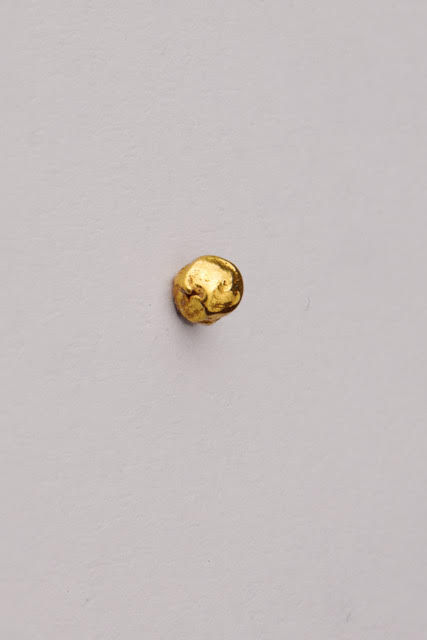
Similarly, in the series Seme (Seed)—a 24-karat gold seed—an extreme proximity to the work is not enough to grasp its features. We can only achieve its completeness through a tool that enlarges its appearance. This is perhaps the first time the artist has granted us an instrument to access the accuracy of the work.
That seed finds its completion inside a package designed to hold 100 specimens—a meager quantity when compared to that of the work Sèma, where, by immersing one’s hands into the black parallelepiped, one can observe a vast quantity of (real) seeds.
In this case, the dichotomy between a living element like the seed and its placement within a sculpture reminiscent of a coffin (the Greek sèma meaning "tombstone") seems explicit. These three works—though I would include a fourth, Lacrime #1 and #2—differ completely from Ludovico’s more recognized research. In them, I found a more complete realization of his indisputable formal skill, spatial management, and the non-passive action of the viewer toward them. The exhibition path is enriched by other works, such as the print series Sèma #1, in which deep blacks are enhanced by mirrored brass inserts, opening up the illusion of archetypal geometries. These black silhouettes shift their shape in relation to the light that hits them. Some of their geometries allude to well-defined solids, almost recognizable as synthetic representations of menhirs. In this series of prints, it is clear how the composition draws from the etymology of the term "sema" (as a minimal linguistic unit) and its variations between semantics and sign. Ludovico seems to take steps backward to recover essentiality, reducing the extension of the sign to a minimum in favor of form.
In the next room, on the wall, Pioggia d’oro (Golden Rain) recalls the formal precision of the Fendenti (Slashes) series. Here too, the installation evokes strong iconography, mixing matter and form into a sign that wounds, or a rain that fertilizes. Nearby, atop a pedestal, the material of the sculpture offers itself as both the container and content of an experience. Lacrime #1 excludes any external reference to draw perception toward a private gesture. The glass sculpture suggests—and the wall work emphasizes—how an emotional practice can become language and how a sculpture can be an object to be experienced. Its forms and materials bring the body closer to a form of knowledge that is no longer passive fruition, but active engagement. This work, though it appears so distinct from the rest of the exhibition, suggests once again how our perception within a context can pass both through a sort of contemplation of the "other" and through a practical action of ourselves.
For this solo exhibition by Ludovico Bomben, I had to navigate a strange balance: the positive sensation that every work aimed to destabilize the first impression. The apparent presentiment of having to move toward and inside the work to complete its meaning; the feeling that every form could only become a figure by averting one's gaze, shifting our own reflection toward it.
I found myself asking (and telling the artist himself) regarding the new works proposed in this show: what is this figure that keeps looking for me? "You are looking at something you don't want to face yet, something you aren't ready to name. You are circling around it, and you keep making all of us circle around it. Sometimes you make us move away to look at the whole; other times you force us closer to confront the detail. Are we the instrument used to measure your works?"
Leaving the exhibition behind, it seems to me that Ludovico wanted to articulate the possibilities that sculpture proposes, in order to move beyond his utopia of world, space, and place. An immediate language made of iconic chimeras. Objects that can be signs or tools, contained images without scale, or rooms dilated by reflection. What is the best perception of this accomplished illusion? Are we the ones passing through these experiences, or are they passing through us? Is Ludovico’s work matter or idea?
Galleria Michela Rizzo
Palazzo Palumbo Fossati | San Marco 2597, 30124 Venezia
martedì-sabato, 10:30-13:00 / 15:00-19:00
+39 0418391711 | +39 3355443326