


Antonio Foscari: Le rive. Il verde. Le ombre (2025-26)
- Dec 17, 2025
- 3 min read
17 December 2025 - 30 January 2026
The three photography series by Tonci Foscari presented at IKONA GALLERY form a single narrative: that of an amphibious city, fragile yet resilient, where the relationship between nature, architecture, and time becomes a subject of reflection.
For years, Tonci Foscari has walked the city’s Rive (the banks) with phone in hand during those rare days of low tide. In those moments, when the water recedes, Venice reveals its submerged edge: steps, stones, and banks covered in algae, where people once descended to reach their boats. It is an almost archaeological vision, witnessing a silent loss—the loss of about a meter of architecture erased by rising sea levels and the alteration of the lagoon’s equilibrium. The rive serve as a visual archive, prompting reflection on the protection of the lagoon and the city’s coexistence with its waters.
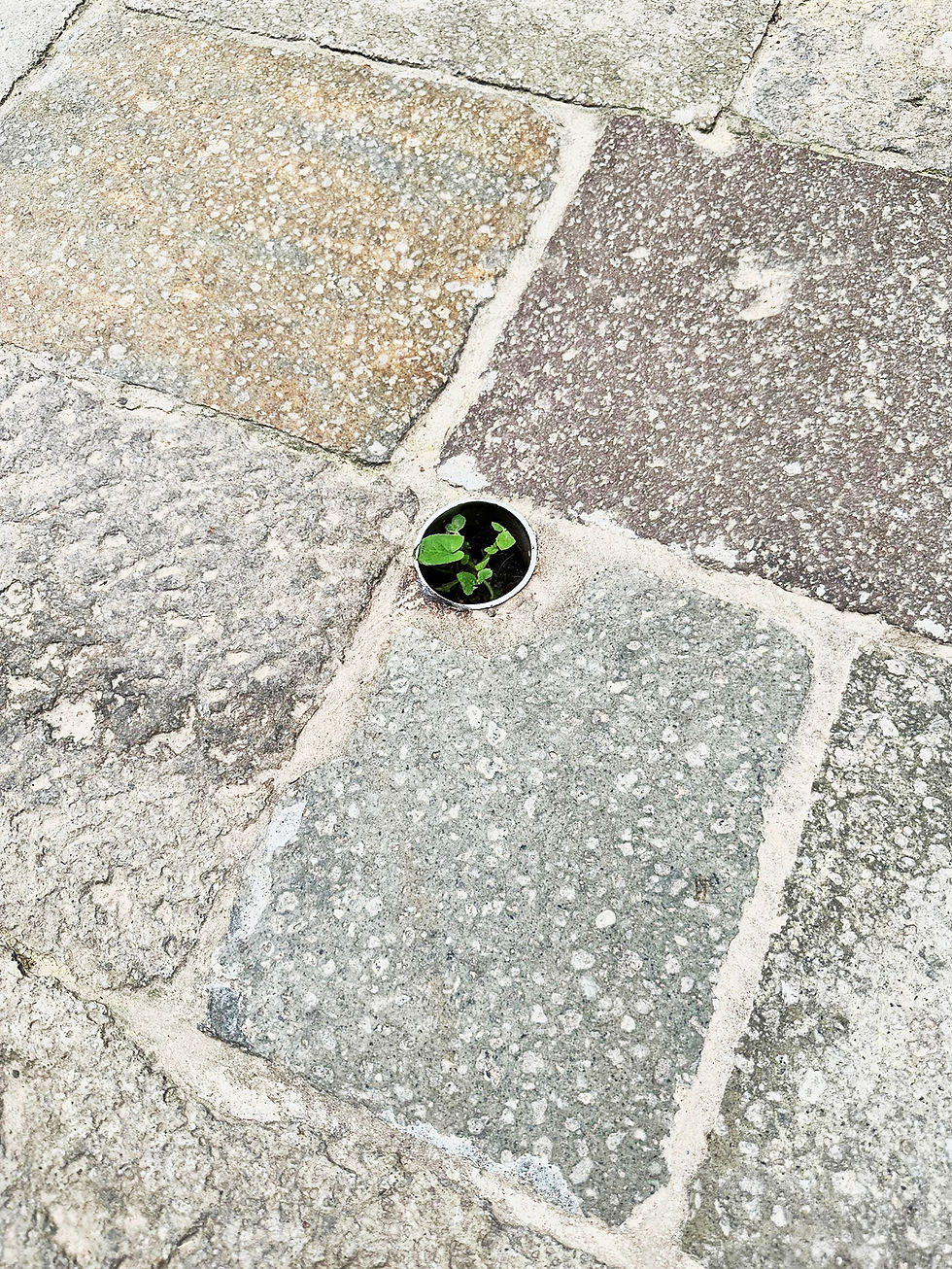
While the banks reveal loss, Il Verde (The Greenery) celebrates the strength of nature. In a city built on water, where the ground is artificial and tree trunks lie buried in mud to support the stone, nature re-emerges in unexpected forms. Foscari photographs tufts of grass sprouting from a gap between masegni (paving stones), plants growing on a rusted tie-rod, and mosses colonizing a forgotten cornice. Here, the green is not an ornament but a gesture of resistance: a silent force reclaiming the urban space.
The third series, Le Ombre (The Shadows), is perhaps the most intimately connected to the author's gaze. Here, Foscari returns to the architectural themes he has long worked on and published, yet he does so through the lightness of light and the transience of projections. Shadows, after all, are the metaphor for a city that lives on reflections—never fully visible, ever-changing, always on the verge of transformation.
Together, the three series form a sensitive geography of the city: the disappearing edge (the banks), the life that persists (the greenery), and the light that defines (the shadows). It is the gaze of an architect and a witness, observing the signs of time without nostalgia, but with the will to understand how the city can still reinvent itself.
ANTONIO FOSCARI Architect and, for many years, Professor of History of Architecture at the Iuav University of Venice.
He is the author of dozens of essays and books on Palladian themes, including: Harmony and Conflicts: The Church of San Francesco della Vigna in Sixteenth-Century Venice (Einaudi, 1983, with Manfredo Tafuri), Andrea Palladio: Unbuilt Venice (Lars Müller Publishers, 2010), Tumult and Order: Malcontenta 1924-1939 (Lars Müller Publishers, 2012), Frescos (Lars Müller Publishers, 2013), Living with Palladio in the Sixteenth Century (Lars Müller Publishers, 2020), and Palladio and the Doge's Palace (Lineadacqua, 2021).
His extensive portfolio of restoration projects and new architectural works includes: Palazzo Grassi, Palazzo Bollani, Palazzo Cavalli, Teatro Malibran, the Sciascia Foundation, the Village of Pollina, and the Center for Advanced Technology Studies in Urbino.
He has served as President of the Academy of Fine Arts of Venice—where he promoted the "Grande Accademia" project—President of the Alliance Française of Venice, and a member of the Venice City Council's Building Commission.
He is Vice President of the Querini Stampalia Foundation and the Fondazione di Venezia. Furthermore, he is a member of the Board of Directors of the Louvre and a member of the Board of Directors of CISA (International Center for the Study of Architecture Andrea Palladio). He is also a member of the scientific committee for the "Lagoon Authority." He has been honored with the Ordre des Arts et des Lettres of the French Republic and the Légion d’Honneur.